How the Monsoon Works: Why It Rains for Months

The word monsoon comes from an Arabic word meaning “season”. It describes a regular change in wind direction between summer and winter, and the heavy rains that arrive with it. In South Asia, the summer monsoon brings most of the year’s rainfall and shapes farming, rivers and daily life.

Land and sea heat up differently
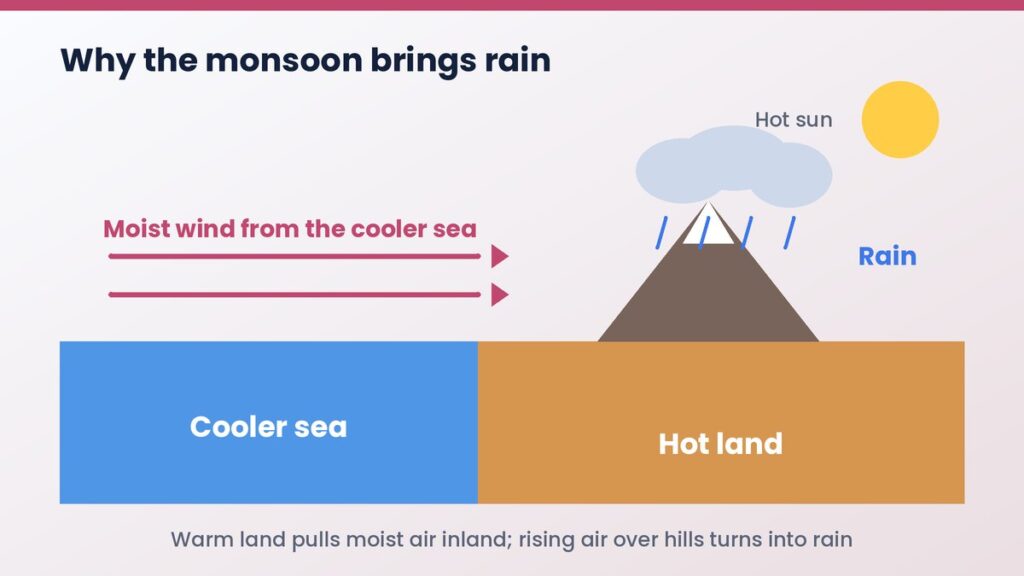
Land warms up much faster than the ocean. As summer arrives, the land becomes hot and the air above it rises, creating an area of low pressure. The cooler ocean has higher pressure, so air starts to flow from the sea towards the land.
Moist winds come ashore
The winds that blow in from the Indian Ocean pick up a huge amount of water vapour. When they reach the coast, they carry that moisture over the land.
Mountains and rising air make rain
When moist air meets mountains such as the Western Ghats or the Himalayas, it is forced upwards. As it rises it cools, the vapour condenses into clouds and the water falls as rain. This is why windward slopes often get far more rain than areas behind the mountains.
The seasonal rain belt moves
Near the equator there is a band of rising air and heavy rain called the Intertropical Convergence Zone. It shifts north in the northern summer, helping to pull the monsoon over South Asia. In winter it moves south and the winds reverse.
Timing and variation
In India, the southwest monsoon usually arrives in Kerala around the start of June, spreads across the country over the following weeks and withdraws from around September to October. Its strength changes from year to year, and patterns such as El Niño and the Indian Ocean Dipole can affect it.
Why it matters
Millions of farmers depend on the monsoon for crops, and it also refills rivers, lakes and groundwater. Too little rain can cause drought, and too much in a short time can cause floods, so forecasts are closely followed.
Key takeaways
The monsoon is a giant seasonal wind system. Heat differences between land and sea set it in motion, moist ocean air feeds it and mountains turn that moisture into rain.