How to Write Better AI Prompts: 7 Simple Rules

If an AI tool gives you a vague or generic answer, the problem is often the prompt, not the tool. The good news is that better prompts are easy to learn. Here are seven rules that work with almost any AI assistant.

1. State your goal clearly
Say what you want to achieve, not just the topic. “Explain photosynthesis” is fine, but “Explain photosynthesis to a 12-year-old in five sentences” is far better.
2. Give context
Tell the AI who you are, who the answer is for and what you already know. A little background lets it skip what you do not need.
3. Choose the format
Ask for exactly what you want to receive: a table, a checklist, three bullet points or a short email. If you want a certain length, say so.
4. Show an example
If you want a particular style, paste a short sample and say “write in a similar tone”. Examples guide the AI better than long descriptions.
5. Set limits
Add simple rules such as “use plain English”, “no jargon”, “under 150 words” or “only use the text I pasted below”.
6. Ask it to check or ask questions
Try “If anything is unclear, ask me questions first” or “list your assumptions”. This stops the AI from guessing.
7. Improve it step by step
Treat the first answer as a draft. Follow up with “make it shorter”, “add an example” or “explain the second point more simply”.
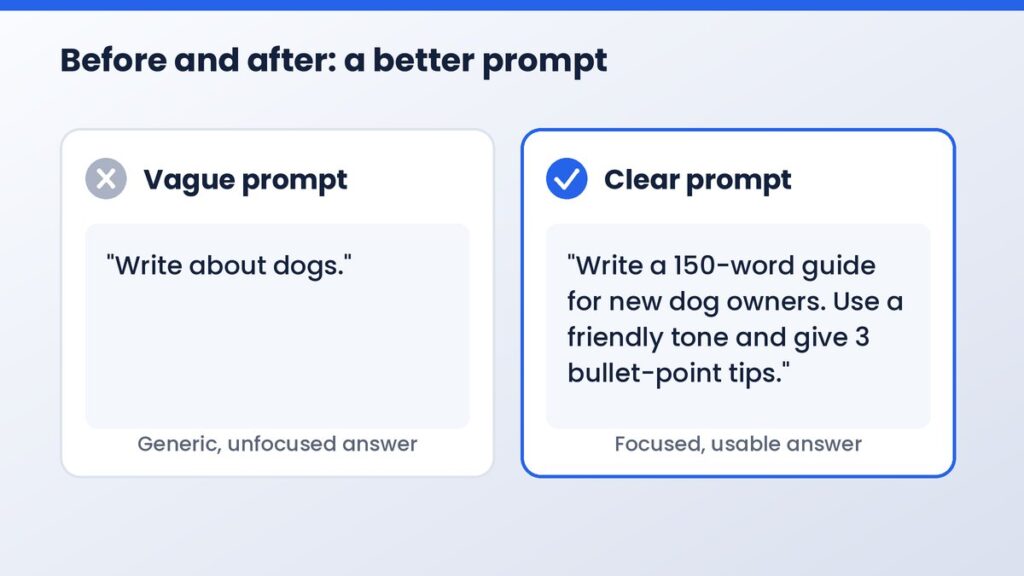
Before and after
Weak prompt: “Write about budgeting.”
Better prompt: “I am a first-year student with a small monthly allowance. Write a simple one-page budgeting guide with a table of categories and three practical tips. Use plain English.”
Always double-check facts, numbers and quotes from an AI tool before you rely on them. A good prompt improves the answer, but it does not guarantee that it is correct.