AI Agents Explained: What They Are and How to Use Them

You have probably used a chatbot that answers a question and stops. An AI agent goes one step further. It takes a goal, breaks it into steps, uses tools such as search, a calendar or a spreadsheet, checks its own work and keeps going until the job is finished or it needs your input.

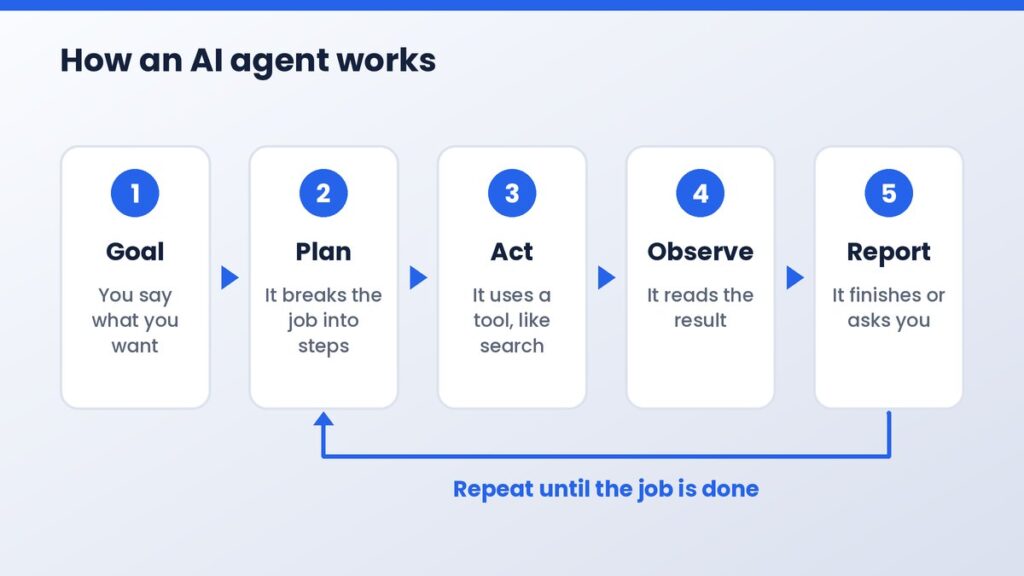
How an AI agent works
Most agents follow the same loop:
- Goal: you describe what you want, for example “find three flights under budget and summarise them”.
- Plan: the agent decides the steps it needs.
- Act: it uses a tool, such as a web search or a spreadsheet.
- Observe: it reads the result and decides what to do next.
- Repeat or report: it loops until the goal is met, then shows you the outcome.
Where agents help today
Agents work best on repetitive, well-defined tasks where a mistake is cheap to fix:
- Researching a topic and summarising the sources
- Drafting emails and organising meeting notes
- Cleaning up data in a spreadsheet
- Helping with code, such as writing tests or explaining errors
- Sorting customer questions before a human replies
Where they still struggle
Agents are not magic. A small mistake in step two can carry through to step ten. They can misread vague instructions, and they can be tricked by hidden instructions inside web pages or documents they read. That is why you should keep their permissions narrow and never let one spend money, delete files or send messages without your approval.
How to start safely
- Pick one low-risk, repeatable task, such as weekly research or tidying notes.
- Write a clear goal and say what the agent must not do.
- Ask it to show its steps so you can check them.
- Review the result before anything is sent, paid or deleted.
- Expand slowly as you learn where it is reliable.
Key takeaways
An AI agent is a model plus tools plus a loop. It saves the most time on routine work, and it works best when you stay in charge of the final decision. Start small, check the output and build trust step by step.